In the early 1990s, war broke out in Bosnia and Herzegovina. More than 100,000 people lost their lives and over two million were displaced. Rape, prison camps, and the genocide of Bosnian Muslims became commonplace during the war, and it would eventually be remembered as the worst conflict in Europe since the end of World War II.
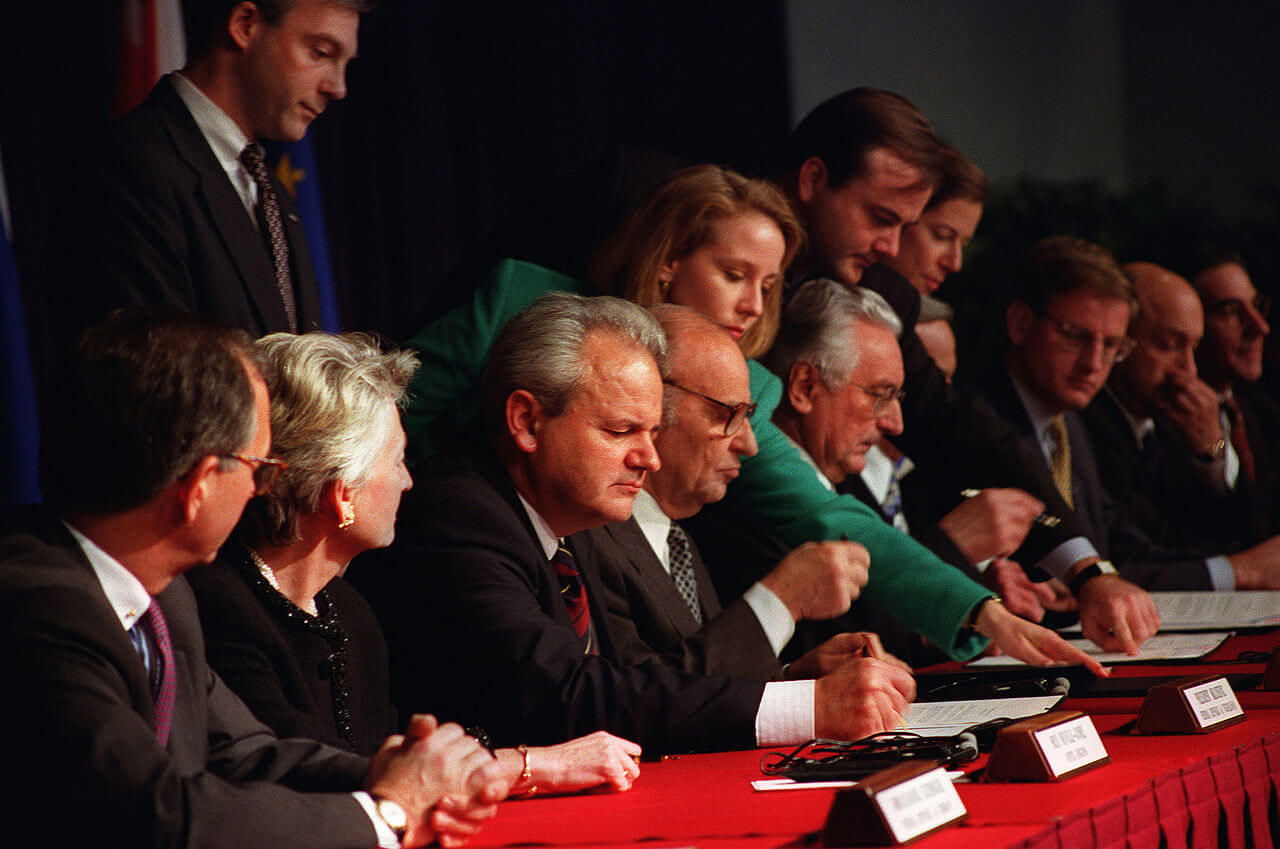
Peace was established on November 21, 1995, under the General Framework Agreement for Peace, commonly known as the Dayton Accords. Formally signed on December 14, 1995, the Dayton Accords are now remembered as an unjust treaty that ended the war but preserved hostilities.
Memories of the Dayton Accords, 1995
The Bosnian War of the 1990s
The war in Bosnia and Herzegovina was triggered by a series of mass atrocities against Bosnian Muslims and fueled by the indecision of the UN and NATO, and the bias of the European Union. In fact, to avoid being killed, Bosniaks repeatedly called for the lifting of the arms embargo. With the arms embargo in place, Bosniaks have no means of defending themselves against the heavily armed and well-equipped Serb and Croat armies.
However, the members of the European Union have consistently refused to adjust or eliminate the arms embargo, leaving the people of Bosnia and Herzegovina without any means of self-defense. As Taylor Branch noted in his famous book, « The Clinton Tapes, » Europe was more than happy to see Bosnian Muslims massacred by Serbs and Croats.
That an independent Bosnia would be « unnatural » as the only Muslim nation in Europe.
French President François Mitterrand had been particularly direct in saying that Bosnia did not belong to us and that British officials were talking about a painful but realistic restoration of Christian Europe.
After all, in Europe, Islamophobia and racism are not a recent phenomenon.
Genocide in Srebrenica, peace in Dayton
The situation spiraled out of control in 1995 with the Srebrenica massacre. This was a planned genocide in which over 8,000 Bosniaks were killed and more than 40,000 people were expelled from a UN “safe zone” supposedly protected by Dutch peacekeepers. To make matters worse, Western powers, according to declassified US documents, were already aware that the Serbs were planning to attack Srebrenica but chose to remain silent.
Following the Srebrenica incident, NATO launched a bombing campaign in the region, and ultimately, the momentum shifted toward a ceasefire. Peace negotiations in Dayton, Ohio (USA) resulted in the Dayton Accords, signed by Franjo Tudjman, President of Croatia, Slobodan Milosevic, President of Serbia, and Alija Izetbegovic, President of Bosnia and Herzegovina.
Milosevic would later receive the recognition he deserved and be tried as a war criminal, but for some Serbs, he remains a war hero to this day.
The result
The Dayton Accords ended the war, but failed to eliminate hostilities. In fact, it was an unjust treaty, simply because the parties involved had their own set of flaws. The Bosnian delegation lacked unity and a common goal—this is certainly no surprise; after all, if the Muslim entities had been united, none of the Western atrocities would have occurred in the first place! The Serbian delegation, led by Milošević, had no interest in peace and simply wanted to escape responsibility for their crimes. The Croats, on the other hand, cared little for their neighbors. As Richard Holbrooke , head of the American delegation in Dayton, noted:
Each side challenged the prospects for success in its own way: the Bosnians were disorganized, Milosevic dishonest, and Tudjman disengaged.
Conclusion
Following the Dayton Accords, Bosnia and Herzegovina was divided into two parts: almost 51% of the territory was given to the Federation of Bosnia and Herzegovina, while 49% of the territory went to the Republica Srpska.
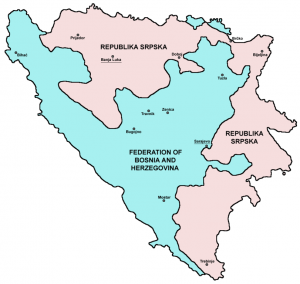
Naturally, the Accords failed to deliver justice: the creation of the Republica Srpska meant the creation of a new entity founded on genocide and the ethnic cleansing of innocent people. By accepting Milošević’s unjust demands and creating the Republica Srpska, the architects of the Dayton Accords ignored the crimes of genocide and simply rewarded the perpetrators.
Today, two decades have passed, but the shadow of the 1990s conflict persists. Heterogeneous coexistence is relatively unknown in the region, and nationalist and communal tensions remain endemic.
However, the Dayton Accords deserve some credit. At the time, the war would not have ended without them. Moreover, today, despite ethnic polarization, Bosnia and Herzegovina remains a united state. The future cannot be predicted, and while ethnic, regional, and communal tensions persist, the prospects for peace are not entirely hopeless.
All images (C) Wikimedia Commons