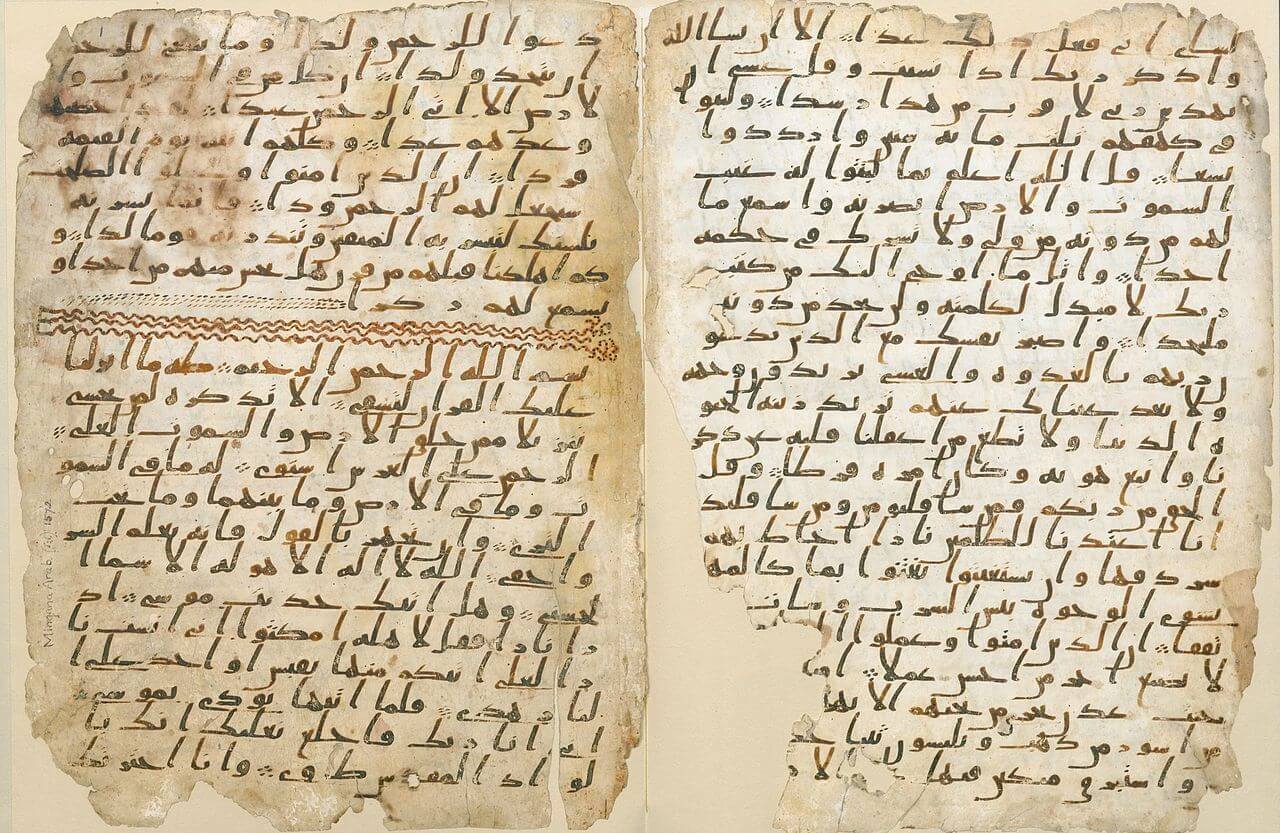
At the University of Birmingham, scientists recently dated an ancient Quranic manuscript using radiocarbon dating. It turns out that this manuscript is one of the oldest of all time! Written on parchment, it dates back to sometime between 568 and 645 CE.
Since the Prophet Muhammad (peace be upon him) himself lived from 570 to 632 CE, this means that this Quranic manuscript belongs to the Prophet’s lifetime. It is, therefore, entirely possible that the Quranic verses were written on the parchment by a companion of the Prophet, or perhaps by a student of one of these companions. The calligraphy and lettering on the parchment are in excellent condition, thus proving that it is the work of an experienced hand.
So, what does this « newly discovered » old Quranic manuscript tell us?
The manuscript: at a glance
The two pages of the manuscript are written in ink on parchment, using a clearly legible Hijazi Arabic script. The pages contain portions of Surahs 18 to 20.
Since the manuscript was probably intended for Arabic speakers and native readers, there are no special diacritical marks for vowels, but consonants are marked with slashes.
There are many messages that this old parchment of Quranic letters has transmitted to us.
1. Islamophobes are wrong
Time and time again, Islamophobes continue to wrongfully accuse Islam: they claim that the Quran originated in a period after the Prophet Muhammad (PBUH), and sometimes they even go so far as to say that the Quran is no longer the same as it once was!
Such ridiculous accusations are obviously false, and this new discovery at the University of Birmingham is a major blow to Islamophobes worldwide.
2. The Quran is intact
Clearly, since this manuscript belongs to a time when the Quranic revelation was still ongoing (i.e., the lifetime of the Prophet Muhammad, peace and blessings be upon him), it is once again proven beyond any doubt that the authenticity of the Quran is indisputable.
Of course, we Muslims have known this from day one. But for anyone who has even an ounce of doubt: feel free to compare this newly found manuscript, or the 7th-century Quranic parchment found in Sana’a, or the 800-something CE Quranic manuscript from Samarkand, with the current version of the Quran.
Yes, the Quran is intact and unedited.
3. The concept of memorization
For centuries, Islamic scholars understood and utilized the power of the human brain. At the time, the luxury of backing up their precious data on multiple hard drives and cloud storage was unavailable. Thus, to preserve the Quran and other important knowledge, Islamic scholars turned to the only unlimited storage option they were aware of—the human brain.
Memorizing the Quran has been a branch of study in its own right, and for centuries Islamic scholars have memorized the entire text of the Quran, word by word, syllable by syllable.
Of course, the current education system focuses more on external technology than on human memory, such as the use of calculators and computers. Yet, the power of memorization has played a major role in preserving the Quran throughout the ages.
4. Our heritage belongs to non-Muslims
The question that should now be asked is: what is such a precious and ancient Quranic manuscript doing in Birmingham? Granted, the Quran is available worldwide and is a message for all humanity rather than just a group of Muslims, but why is it that Islamic heritage today is being organized by non-Muslims?
Have we, as a community and civilization, become so intellectually lazy that we cannot take care of our own heritage?
I don’t think anyone has a direct answer to that. In any case, regardless of where in the world one is located, the authenticity of the Quran remains guaranteed. As Allah said in the Quran 15:9 (Surah al-Hijr):
Indeed, it is We who sent down the Qur’an, and indeed, We will be its guardian.
All images © University of Birmingham