Surah al-Kawthar, or « the abundance », is the 108th surah of the Quran. It is the shortest surah, consisting of only three verses.
Surah al-Kawthar was revealed to console and encourage the Prophet Muhammad (PBUH), as he faced a multitude of painful incidents and much mockery from his enemies.
This article provides the complete translation and tafsir of Surah al-Kawthar, along with the Arabic text.
Surah al-Kawthar, or « the abundance », is the 108th surah of the Quran. It is the shortest surah, consisting of only three verses.
Surah al-Kawthar was revealed to console and encourage the Prophet Muhammad (PBUH), as he faced a multitude of painful incidents and much mockery from his enemies.
This article provides the complete translation and tafsir of Surah al-Kawthar, along with the Arabic text.
Translation and Tafsir of Surah al-Kawthar
First, the complete Arabic text of Surah al-Kawthar:
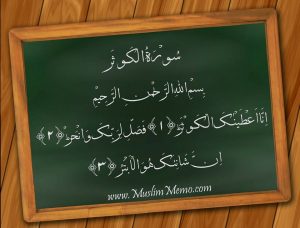
Translation
We have certainly granted you abundance.
So pray to your Lord and sacrifice.
Indeed, your enemy will be without posterity.
And now, let’s move on to the Tafsir of Surah al-Kawthar.
Tafsir

1. We have certainly granted you abundance.
The term « Kawthar » is a descriptive case derived from the word « kathrat, » which can be understood as meaning « abundance »—that is, an abundance of goodness, spiritual benefits, and blessings. Such abundance is boundless and limitless. In this verse, Allah conveyed the glad tidings of such an abundance of goodness to the Prophet Muhammad (peace and blessings be upon him).
Hz Ibn Abbas (RA): [1]
The word « al-Kawthar » means the abundant good that Allah gave him, i.e., the Prophet Muhammad (PBUH).
The purpose of this verse was to strengthen the Prophet’s (PBUH) resolve and also to stimulate the resolve of the Muslim community by reminding them of their Lord’s promise. To quote Surah Ad-Duha: [2]
Your Lord will surely grant you [His favors], and then you will be satisfied.
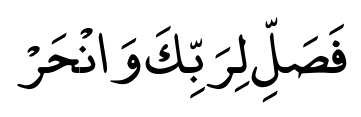
2. Perform prayer to your Lord and sacrifice.
Allah alone can bestow such abundance, so thanks should be offered only to Him. This verse reminds us that we must remain steadfast: our prayers are solely for Allah, and our sacrifices are for Him alone, unlike polytheistic practices where self-made gods are worshipped.
In Surah al-An’am, Allah says: [3]
Say: « Indeed, my prayer, my acts of devotion, my life and my death belong to Allah, Lord of the Universe.
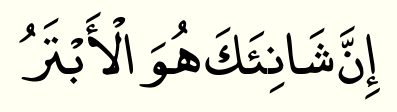
3. He who hates you will certainly have no offspring.
The last verse of this short surah refers to the mockery made by the pagan leaders, who used to say that the Prophet Muhammad (peace and blessings be upon him) was « abtar, » meaning « without posterity » (one who has no male offspring). They used to claim that because of the death of all his sons, the Prophet Muhammad (peace and blessings be upon him) would not be remembered by future generations.
Clearly, these taunts and remarks revealed nothing more than the ignorance of the pagan leaders. Allah ensured that the Prophet Muhammad (peace and blessings be upon him) would not only be remembered, but would serve as a model for generations upon generations.
References
Sahih Bukhari Vol 8, Book 76, Hadith 580
The Quran 93:05 (Surah ad-Duhaa)
The Quran 06:162 (Surah al-Anam)