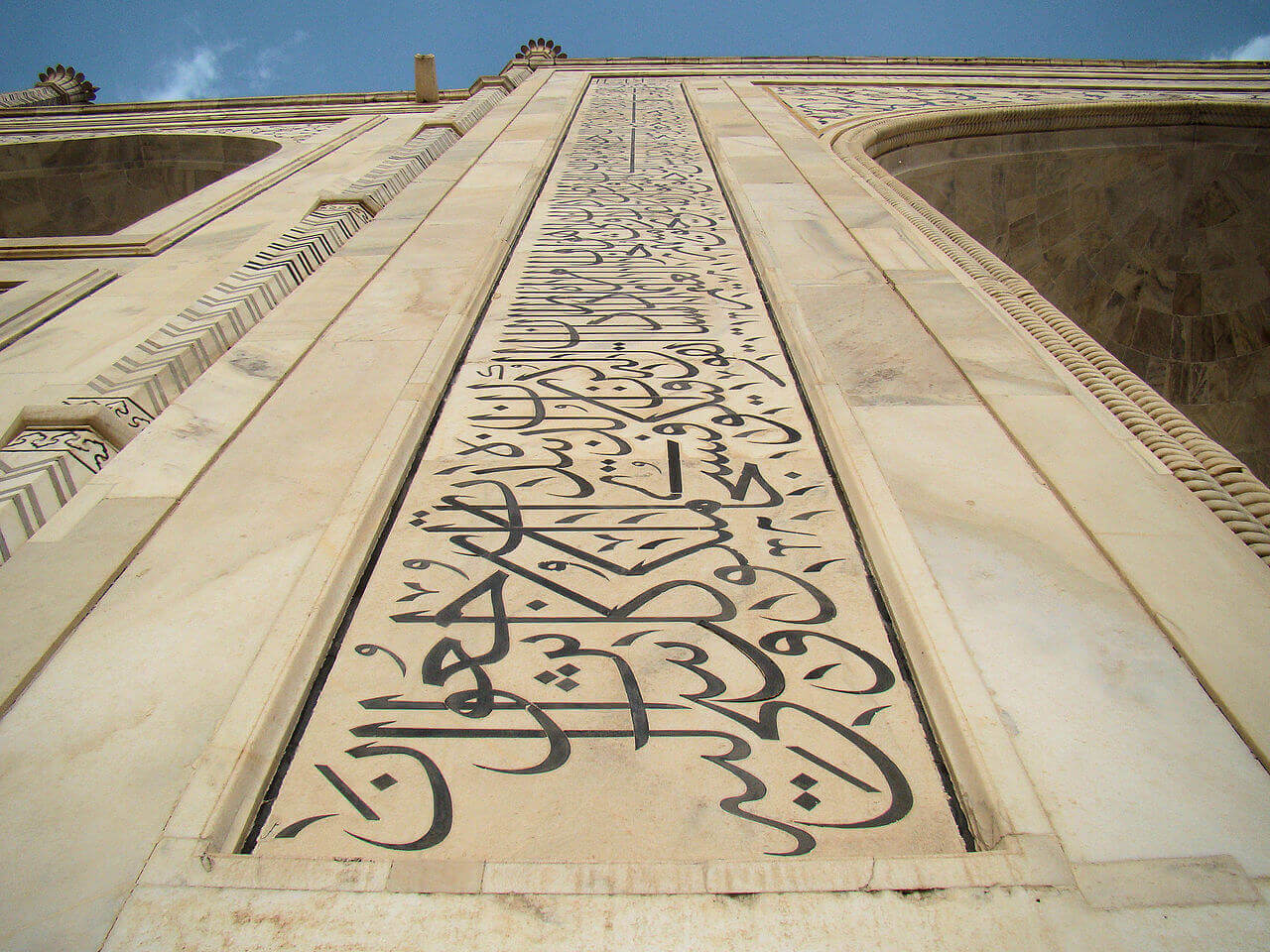
Surah An-Nasr is the 110th surah of the Quran and is one of the shortest surahs, consisting of only three verses. The surah takes its name from the word « nasr » which appears in its first verse. Surah An-Nasr was the last surah revealed; no other complete surah was revealed after it. [1]
Hz Ubaidullah bin Abdullah bin Utba (RA) reported:
Ibn Abbas (RA) said to me: Are you aware of the last surah that was revealed in the Quran as a whole? I said: Yes, « When the help of Allah and the victory came. » Then he said: You have spoken the truth.
This article provides the complete translation and tafsir of Surah An-Nasr, along with the Arabic text.
First, the complete Arabic text of Surah An-Nasr:
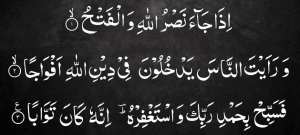
Translation
When Allah’s help and victory come,
and that you see people entering the religion of Allah in multitudes,
So, through praise, celebrate the glory of your Lord and implore His forgiveness. For He is the One who greatly accepts repentance.
And now, let’s move on to the Tafsir of Surah An-Nasr.
Tafsir
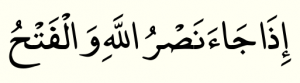
1. When Allah’s help and victory come,
The victory in this verse refers to the conquest of Mecca. There can be no victory without the help of Allah. [2]
Allah only did this to bring you good tidings and to reassure your hearts. Victory comes only from Allah. Allah is All-Powerful and All-Wise.
In Surah Al-Imran, Allah says: [3]
If Allah gives you His help, no one can overcome you. If He abandons you, who is there after Him who can help you? In Allah should the believers put their trust.
Before the conquest of Mecca, Allah gave the Muslims the good news of this great victory in Surah al-Fatah, on the occasion of the Treaty of Hudaybiyyah (an agreement that took place between the Prophet Muhammad (peace be upon him) and the Quraysh of Mecca, although most of the clauses of the treaty were against the Muslims). [4]
In truth, We have granted you a resounding victory,
Allah guaranteed this victory to the Muslims after a long period of trials and patience.
This verse also indicates that Allah fulfilled His Messenger’s mission by enabling him to successfully convey the message. [5]
Narrated by Ibn Abbas (RA):
Umar (may Allah be pleased with him) asked the people about Allah’s statement: « When will Allah’s help come (to you, O Muhammad, against your enemies) and the conquest of Mecca? » They replied: « This indicates the future conquest of cities and palaces (by the Muslims). » Umar said: « What do you say to this, O Ibn Abbas? » I replied: « (This surah) indicates the end of Muhammad’s life. Through it, he was informed of the imminence of his death. »

2. And that you see people entering the religion of Allah in multitudes,
In truth, the conquest of Mecca opened a new chapter in the history of Islam. Immediately, many Arab tribes resisted joining the Prophet Muhammad (peace be upon him). They wanted to see who would emerge victorious between him and the Quraysh. They reasoned that if the Quraysh were victorious, then the Prophet Muhammad (peace be upon him) was not truly a prophet! But if he were victorious, they reasoned, then he must truly be a Messenger of Allah. [6]
Hz reported by Amr bin Salama (RA):
And the Arabs (other than the Quraysh) delayed their acceptance of Islam until the Conquest (of Mecca). They said, « Leave him (i.e., Muhammad) and his Quraysh people alone: if he overcomes them, then he is a true Prophet. » Thus, when Mecca was conquered, every tribe rushed to embrace Islam.
With the Prophet’s (peace be upon him) victory over Mecca, the Arab tribes flocked to Islam in great numbers.
Soon, the entire Arabian Peninsula had embraced Islam. His victory was proof that he was truly a messenger of Allah.

3. So, through praise, extol the glory of your Lord and implore His forgiveness. For He is the One who greatly accepts repentance.
Allah is the One who grants victories, so we must thank Him. That is why, in this verse, Allah tells us to celebrate His praises and thank Him. Here is an alternative translation of the same verse, in image form:

You can visit Quranic quotes for more images of this type.
To quote the first verse of Surah al-Fatiha: [7]
Praise be to Allah, Lord of the universe.
And the best way to declare the perfection of Allah and to celebrate His praises is to offer Him prayers (Salah) and to prostrate as mentioned in Surah al-Hijr: [8]
So glorify your Lord with His praise and be among those who prostrate themselves;
Furthermore, since no human being is perfect, one must ask Allah for forgiveness for one’s mistakes. For example, the prayer of the Prophet Yunus (peace be upon him), as mentioned in Surah al-Anbiya: [9]
And Dû’n-Nûn (Jonah), when he departed in anger, thinking that We would not test him, then he called out in the darkness, « There is no deity except You; exalted are You! Indeed, I have been of the wrongdoers. »
Moreover, in this verse, Allah also reminds us that He is the Most Merciful and the Forgiving, as He did in Surah Nuh: [10]
So I said, « Seek forgiveness from your Lord, for He is the Most Forgiving,
Finally, it must certainly be said that Allah blesses our beloved Prophet Muhammad (PBUH), who always continued to praise Allah and ask for His forgiveness, both for himself and for the Ummah.
Hz Aisha (RA) reported: [11]
The Messenger of Allah (peace and blessings be upon him) often recited, before his death: « Glorified be You, and with Your praise, I ask Your forgiveness and I return to You.
I said, « Messenger of Allah, what are these words that I find you reciting? »
He said: There was a sign for me in my Ummah; when I saw it, I uttered these words of glorification to Allah, and the sign is: “When the help of Allah and victory come, and you see people entering the religion of Allah in multitudes, extolling the praises of your Lord and seeking His forgiveness, for He often returns (in grace and mercy).”
References
- Sahih Muslim Book 43 Hadith 7174
- The Quran 08:10 (Surah al-Anfal)
- The Quran 03:160 (Surah al-Imran)
- The Quran 48:01 (Surah al-Fath)
- Sahih Bukhari Vol 6 Book 60 Hadith 493
- Sahih Bukhari Vol 5 Book 59 Hadith 595
- The Quran 01:01 (Surah al-Fatihah)
- The Quran 15:98 (Surah al-Hijr)
- The Quran 21:87 (Surah al-Anbya)
- The Quran 71:10 (Surah Nuh)
- Sahih Muslim