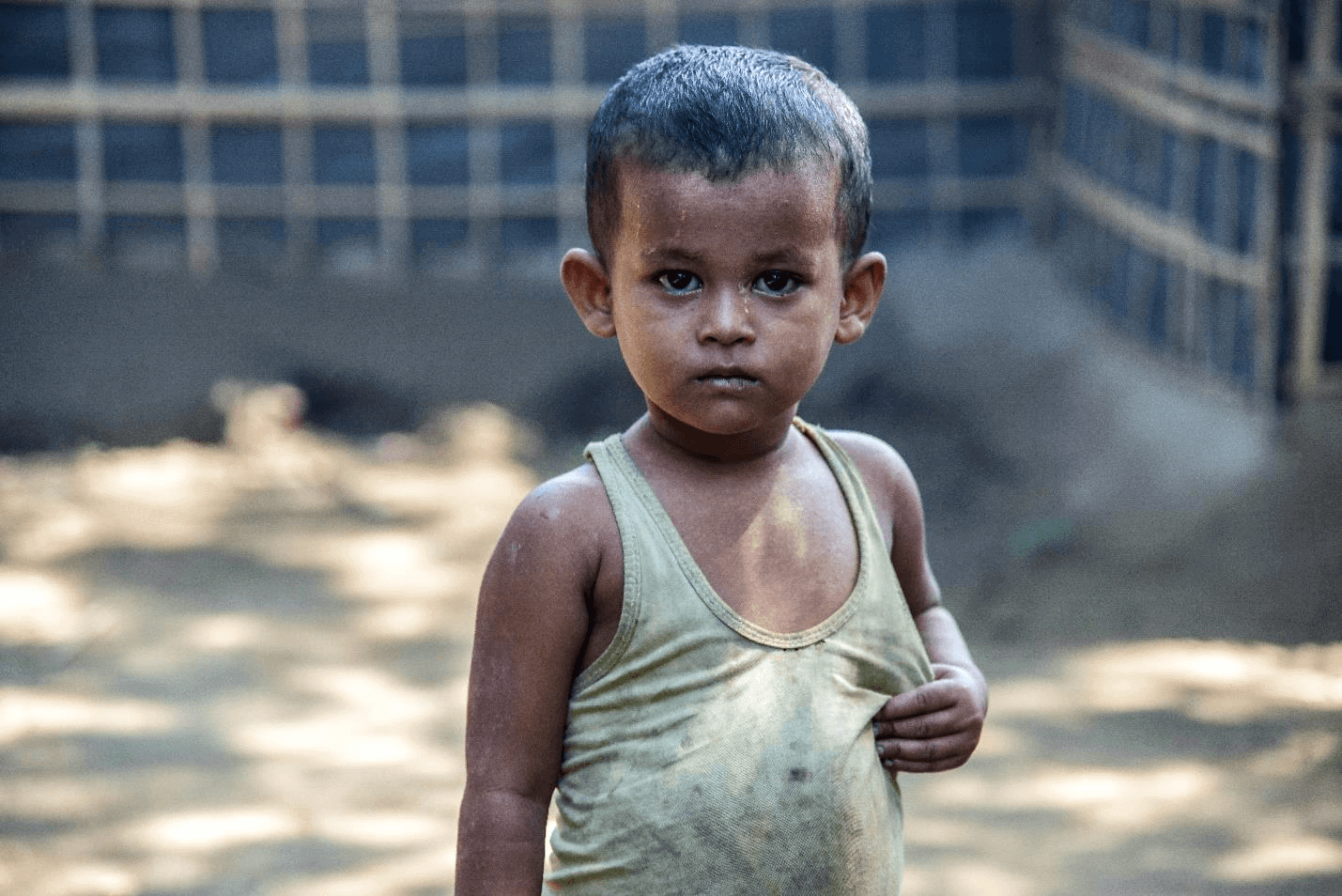
For a long time, we have heard about the violence against Rohingya Muslims in Myanmar (Burma). But what exactly is it?
The violence against Rohingya Muslims is symptomatic of a long and oppressive history of discrimination for which the Buddhist-majority government of Myanmar is responsible. Forced to endure the brutality and oppression of the military junta, more than 200,000 Rohingya fled to Bangladesh in the late 1970s.
Violence against the Rohingya: brutality in Myanmar
In 1982, Burma revoked the Rohingya’s citizenship and ceased to recognize them as one of the 135 « national races. » Since then, the Rohingya have been denied their most basic human rights, such as the right to own land, to identify themselves, to access healthcare, freedom of movement, education, and to marry without government authorization. They have been subjected to forced labor. Even worse, they are forced to undergo sterilization under the population control laws enforced by the government.
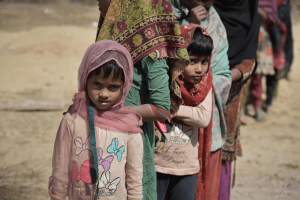
Rohingya children queue for a ration of rice for their families. This is when the area is calm enough for people to receive aid. At other times, refugees would have been too afraid to go to a distribution for fear of being attacked and robbed by the local population.
The Burmese government and society consider Rohingya Muslims to be illegal immigrants from Bangladesh. Official statements refer to them as « Bengali, » « so-called Rohingya, » or the derogatory « kalar. »
The vast majority of Rohingya refugees remain in Bangladesh, unable to return due to the hostile attitude of the ruling regime in Myanmar. Despised by the Buddhist majority, they are denied citizenship, education, freedom of movement, employment, and more. Systematic violence against the Rohingya has become the norm.

Men, women, and children walk for hours every day in the scorching heat, carrying whatever they can find, to collect water wherever they can. In Leda, many choose a 4-kilometer walk to a natural roadside pond. The water is murky brown. It will be used for cooking and drinking without being treated.
Violence against the Rohingya has forced them to migrate en masse as “boat people,” risking their lives at sea in search of work opportunities outside Myanmar. Many who cannot afford the journey are sent to work on rubber plantations by human traffickers or sold into slavery.

Makeshift schools and madrasas, along with the determination of local people and refugees to care for the students, represent a matter of compassion for the Rohingya in Bangladesh. This is often done at great risk for educators and organizers. “At the moment, the government is not favoring the Rohingya people. So, if we help them, we have to do it in secret because there are many problems,” an imam said.
The rise of right-wing Buddhist extremists has also contributed to the violence against the Rohingya. The chief monk of the 969 movement, Ashin Wirathu, has made it his mission to « save » the country from being invaded by the Rohingya (who represent less than 5% of the population).
Despite Myanmar’s apparent transition to democracy in 2011, violence against Rohingya Muslims has worsened. Yet, trade relations between Myanmar, the United Kingdom, and the United States are booming, raising questions about the human rights record of these « democracies. »
The biggest disappointment has been Nobel Peace Prize laureate Aung San Suu Kyi. Her silence on the issue has been contemptible, and many who fought for her release from house arrest feel betrayed by her lack of concern. Since her party’s landslide victory (in an election that failed to allow the 1.1 million Rohingya to vote), the situation for the Rohingya has only worsened. Aung San Suu Kyi’s government has gone so far as to ask foreign diplomats and organizations not to even use the word « Rohingya. »
It is becoming clear that the Rohingya Muslims have nowhere to go. Their own government is aiding in their massacre.
Learn more about the plight of the Rohingya on the Protect the Rohingya Facebook group.
All photos/captions (C) Danikae | All images were taken in Rohingya refugee camps near the coastal border between Bangladesh and Myanmar